
Nikolai Karakhan (1900–1970)
“Going to Work”
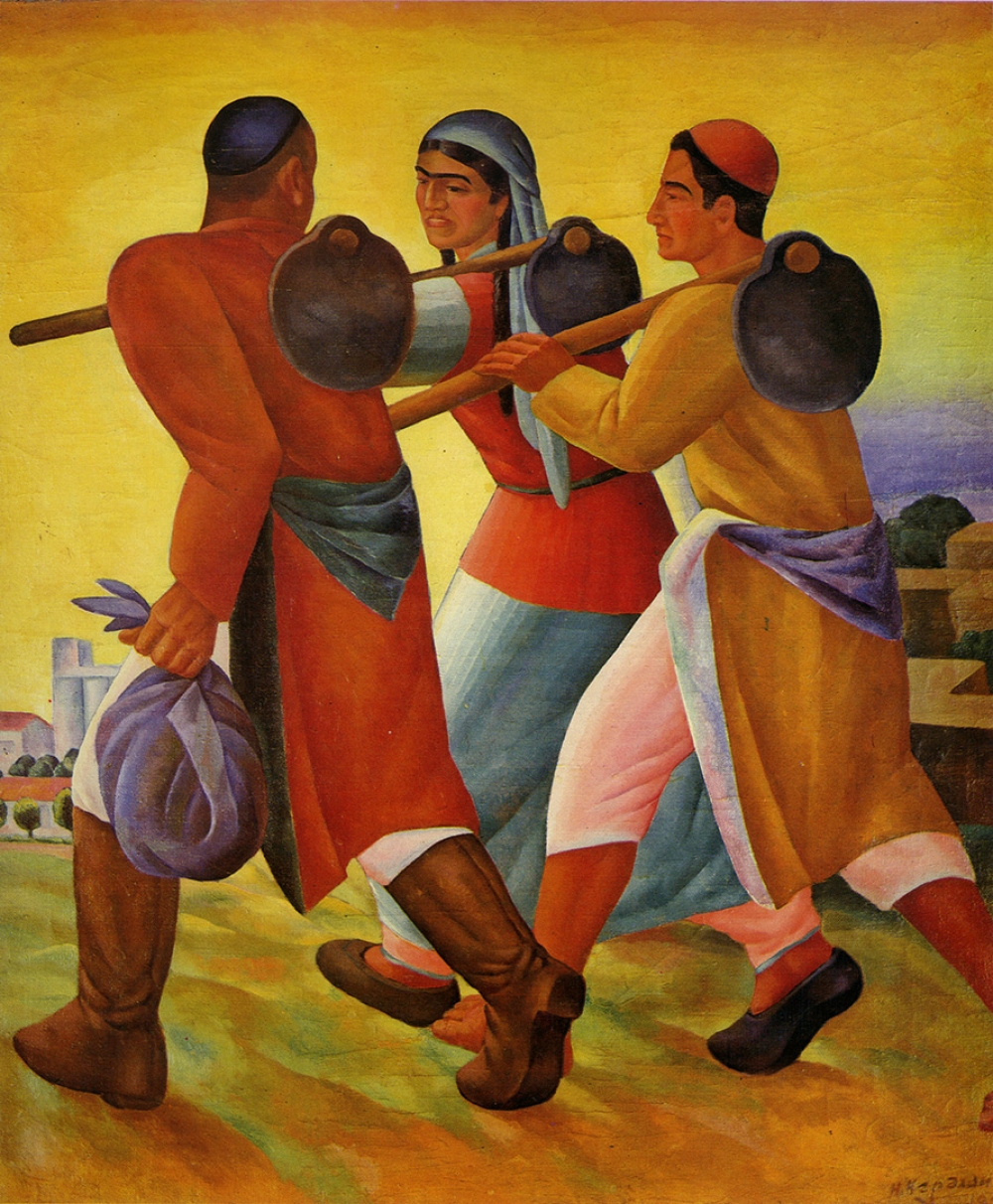
In the foreground, a group of three dehkan farmers is depicted from behind, moving briskly to the left. The group consists of two men and one woman in the center. All of them are dressed in traditional clothing and carry hoes on their shoulders. Behind them, on the right, there is a settlement and a bright yellow sky.
Alexander Shevchenko (1883–1948)
“Portrait of a Power Plant Worker”
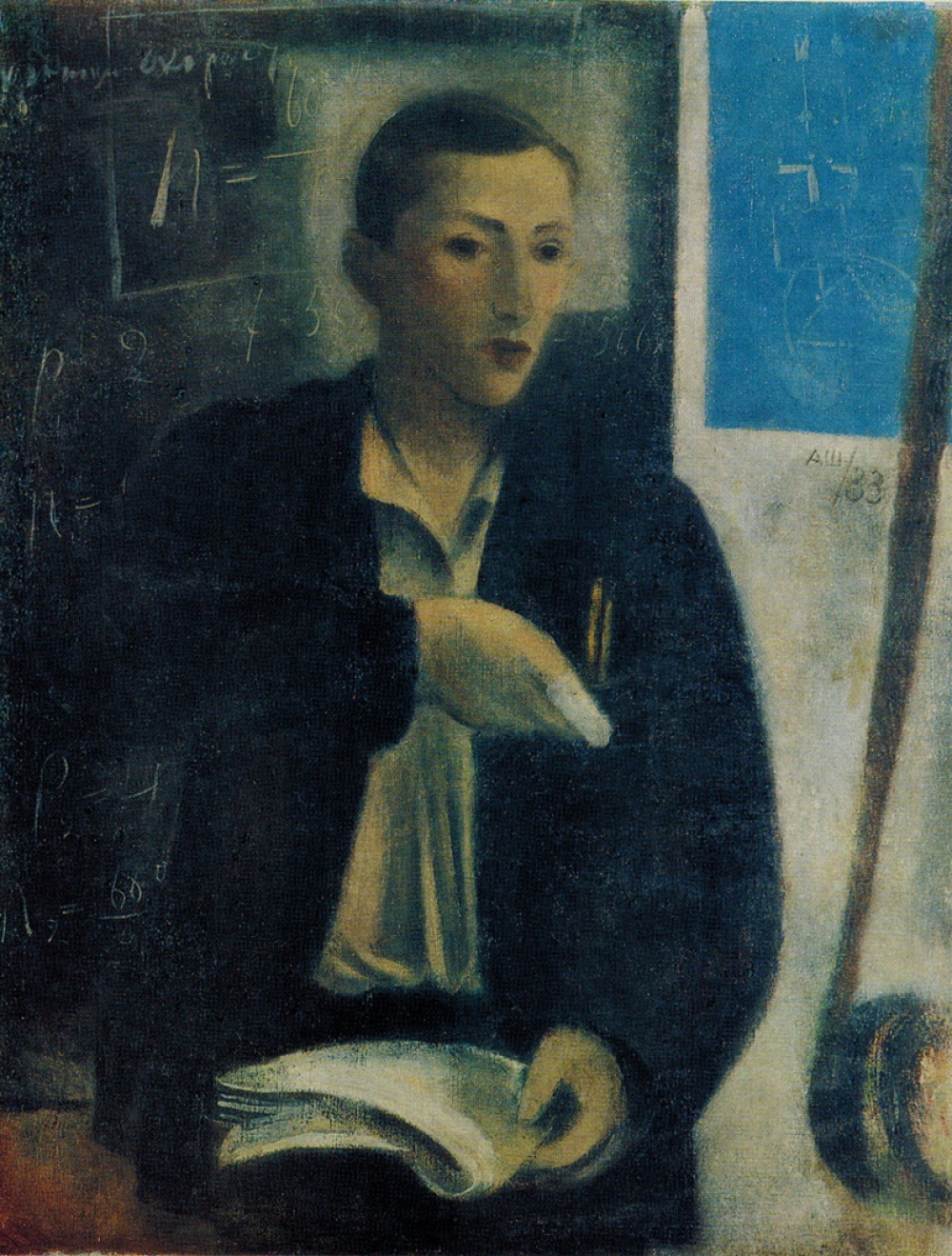
A portrait of a young man shown frontally. His head is turned three-quarters to the right. His right arm, bent at the elbow, is positioned at chest level. His index finger is bandaged. With his left hand, he holds a magazine resting on his knees. He is dressed in a dark suit and a light shirt. Behind him is a blackboard with mathematical formulas, and to the right a gray wall; in its upper part is a blue chart with drawings.
Alexander Volkov (1886–1957)
“Cart”. Reverse side: “Model”
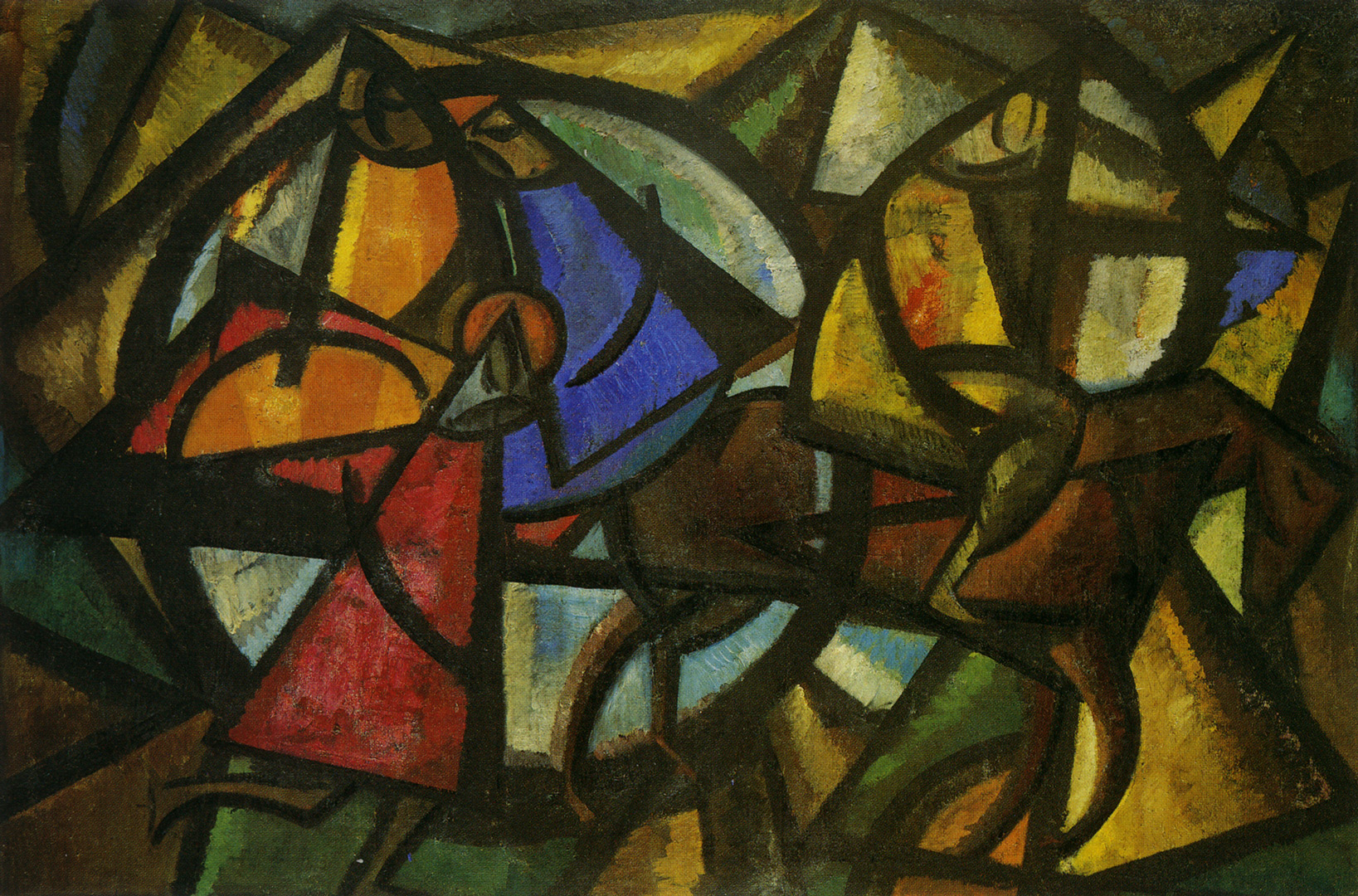
In right profile, a horse harnessed to a cart is depicted. A figure dressed in yellow sits on the horse, leaning its head to the right. On the cart sit two female figures; both tilt their heads to the left—one dressed in orange, the other in blue. In front of the cart is a running figure in red clothing. The two seated women and the running figure are set against the background of the cart’s large wheel. The entire composition is constructed from geometric shapes: triangles, squares, and circles. On the reverse side, a seated nude model is depicted with red and green drapery.
Klement Redko (1897–1956)
“Motherhood”
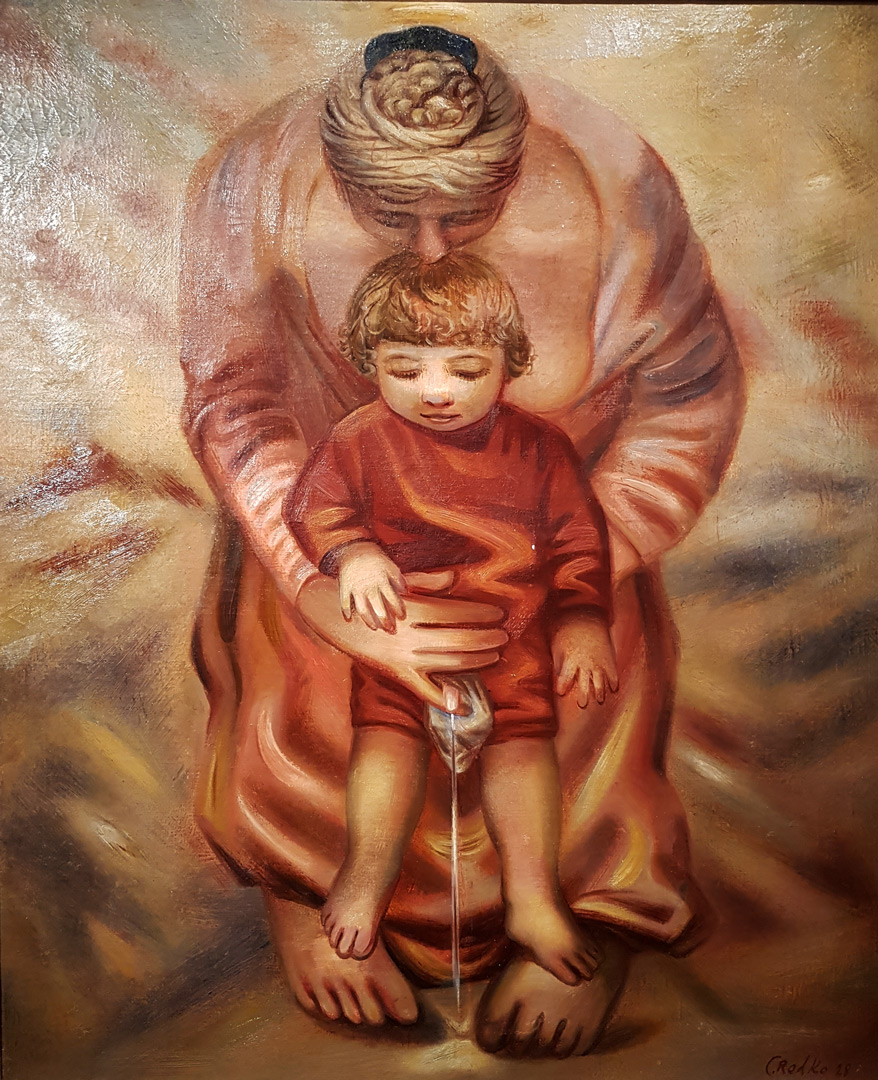
The entire surface of the canvas depicts a woman leaning over a child standing on her legs. The woman’s right hand is placed on the child’s belly. The child is urinating. He is dressed in a brown shirt and short trousers. His hair is light, wavy, with a straight fringe. The woman is depicted in a loose, floor-length dress with a deep neckline. Her hair is gathered at the back of her head in a bun with a blue comb inserted.
Solomon Nikritin (1898–1965)
“Portrait of a Girl in Red”
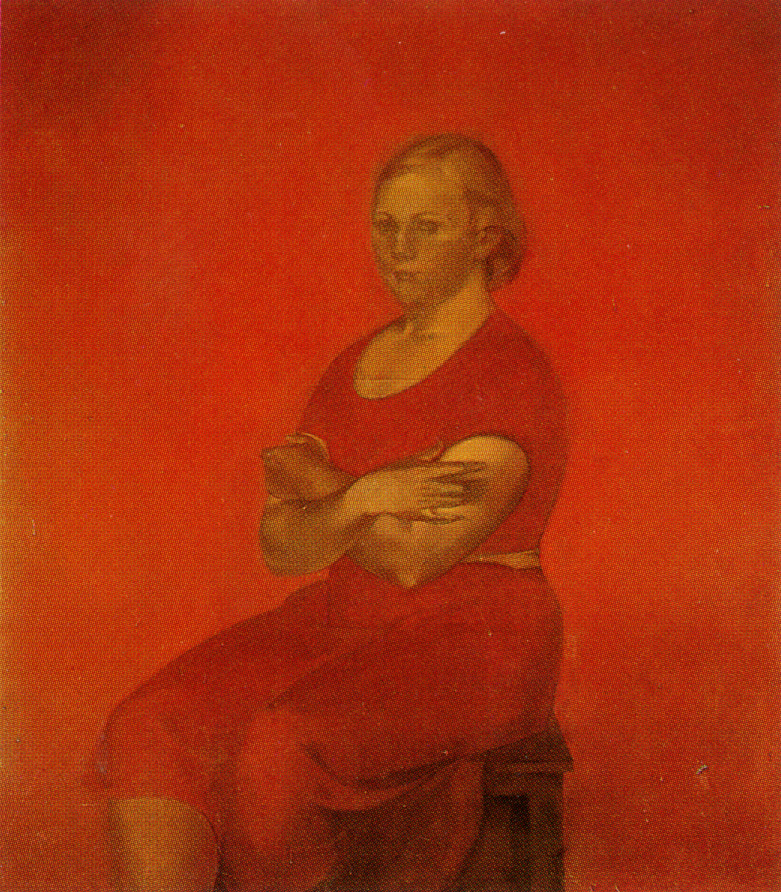
The painting depicts a girl seated on a chair in a half-turn to the left. She wears a red dress with a round neckline and short sleeves. Her arms are crossed over her chest. The lower part of her legs is cropped by the edge of the canvas. The stool is red-brown. The background is red, slightly lighter than the dress.
Konstantin Istomin (1886–1942)
“Moscow Landscape”. 1922
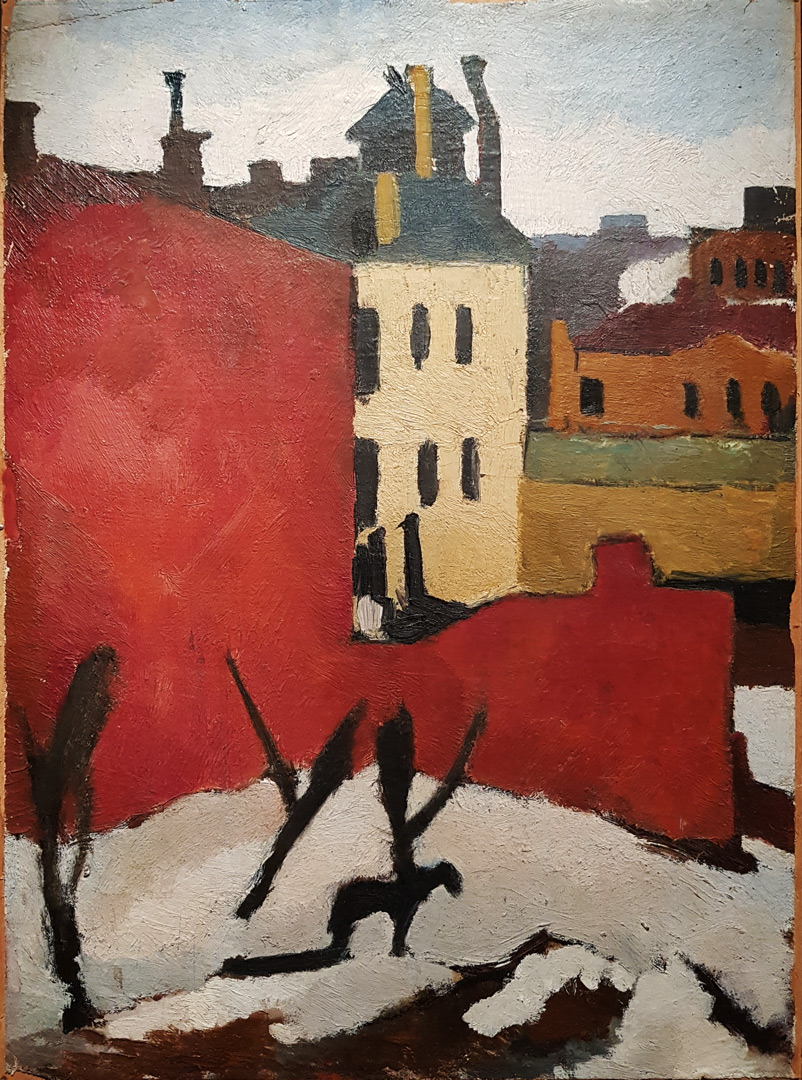
In the foreground, there is a corner of a snow-covered yard, where three twisted trunks of leafless bushes appear dark. In the middle ground on the left is a brownish-red blank wall of a tall building, adjacent to a lower structure of the same reddish-brown color with a short chimney. Behind them, to the left, rises a building with a light-colored wall, black windows, and a dark greenish roof with chimneys, above which towers and pipes of other city structures appear. On the right, stretching diagonally into the depth, are roofs and walls of lower houses with dark window openings. The sky is pinkish-blue.
Elena Korovay (1901–1974)
“The Tailors”
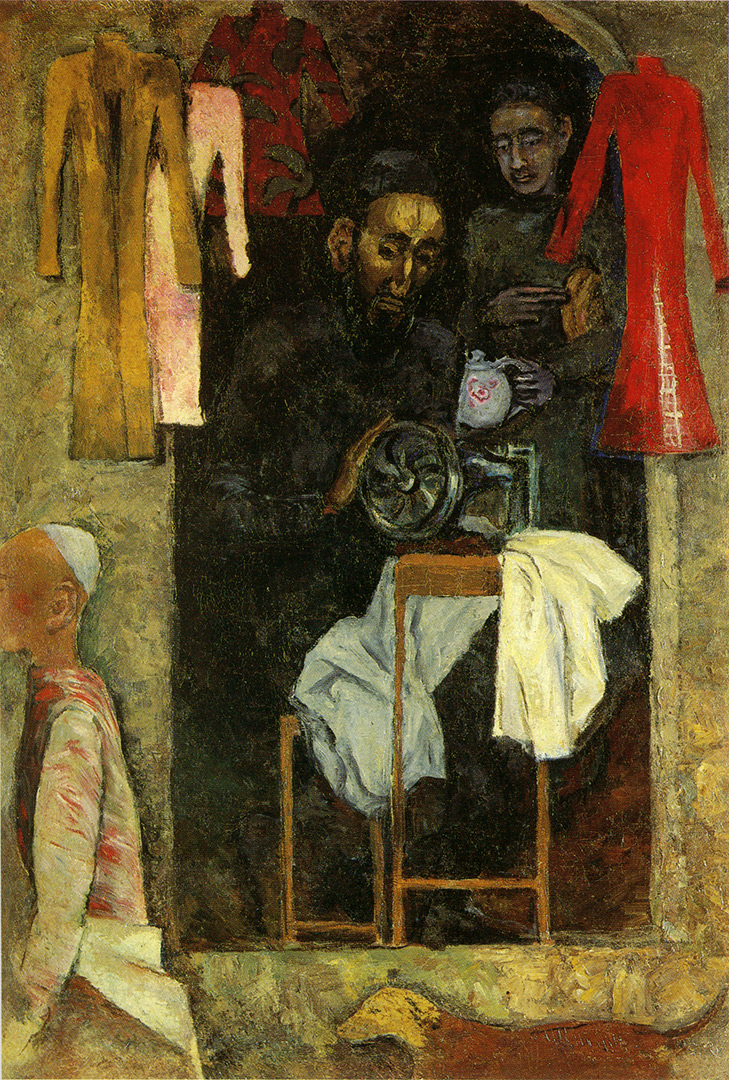
In a pointed arch opening, the figure of a man dressed in black clothing and a black cap is outlined, seated on a stool by a sewing machine, sewing something from white fabric. To his right, in the depth of the space, stands a boy in green holding a porcelain teapot and two flatbreads. Outside, samples of garments are hanging. On the left are ochre and pink robes, and on the right a dark red one. On the left side, a walking boy is depicted, his profile cut off by the edge of the composition, while his legs and the lower part of a dog running after him are also cropped by the edge of the canvas. The painting is impasto, in some places applied with a palette knife.
Ural Tansykbaev (1904-1974)
«Crimson autumn». 1931
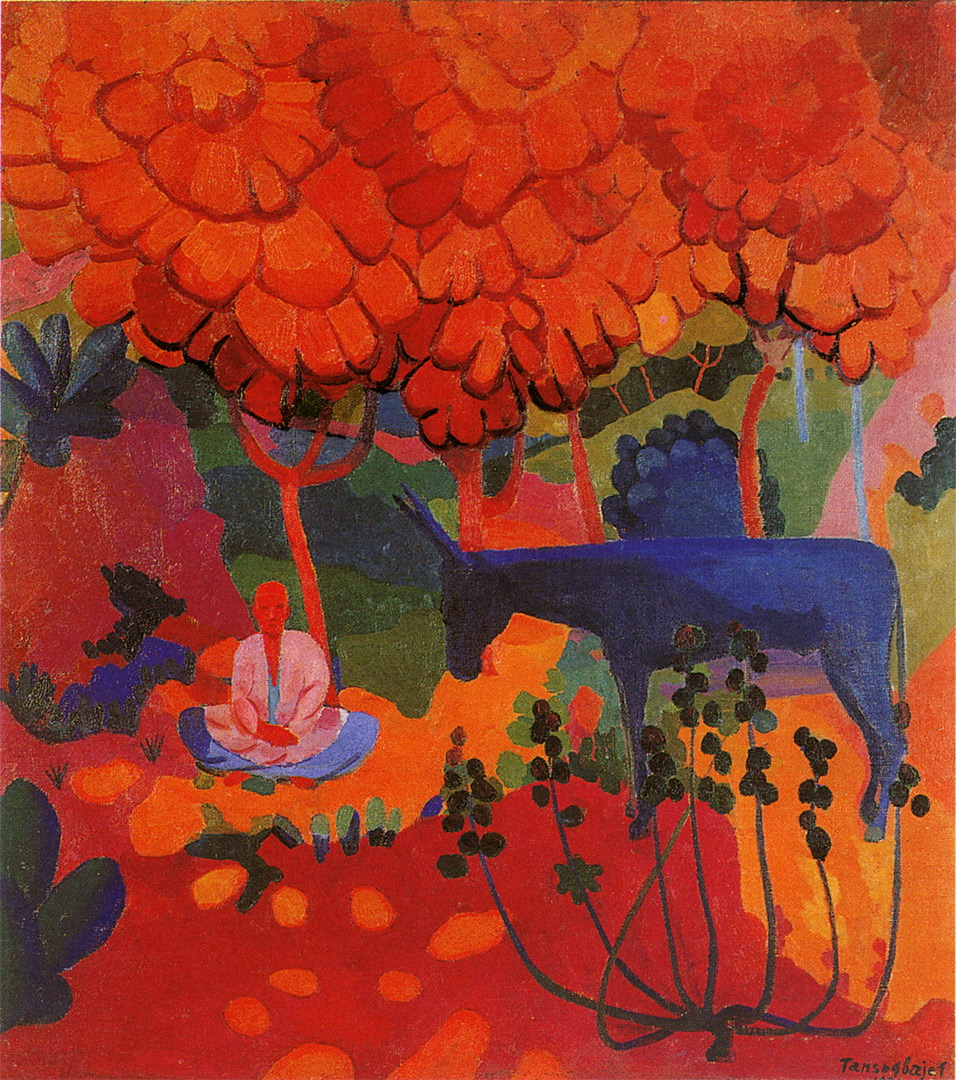
In the foreground, at the bottom, a burgundy shadow falls across the orange surface of the ground. On the left is part of a plant with large, массивные leaves. On the right is a spider-like plant with small, rounded leaves.
In the middle ground, on the left, a man is depicted seated under a tree, shown frontally, wearing blue trousers and a pink robe. On the right, in profile, is a blue donkey. Behind it stand three trees. The crowns of all four trees merge, resembling orange-colored blossoms.
Behind the trees are light-green and dark-green slopes of hills.
Igor Savitsky (1915 – 1984)
«Square in Front of the Council of Ministers»
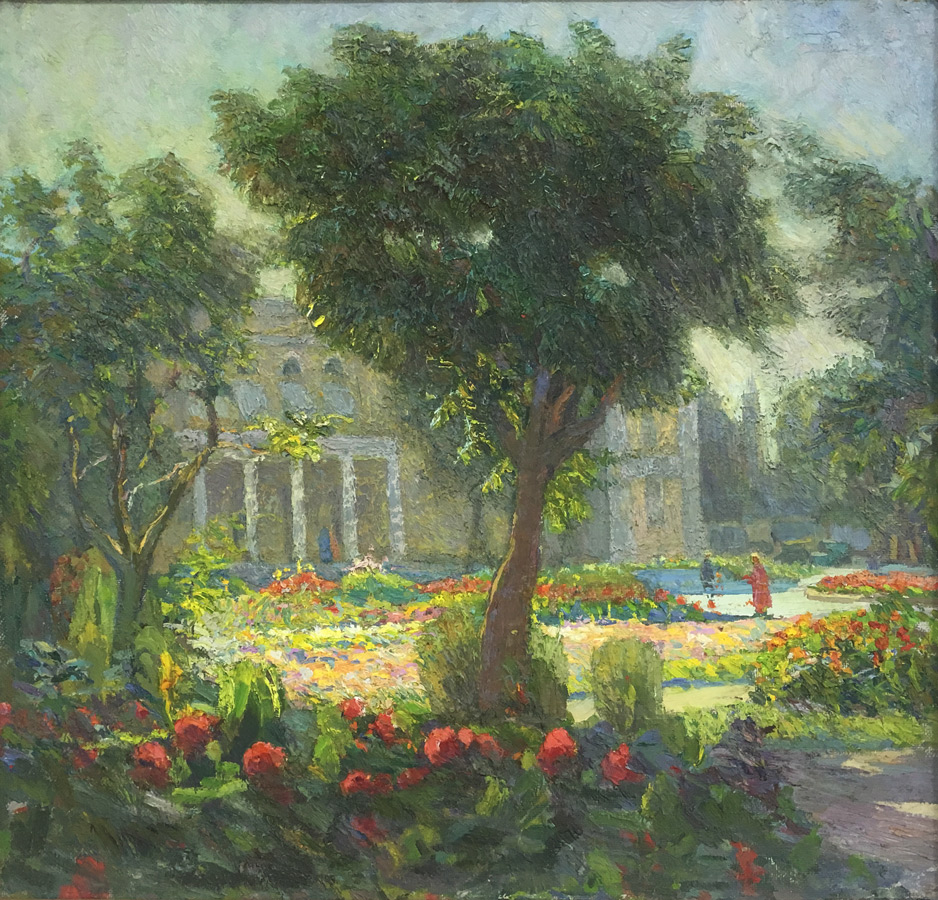
Behind the trees, in the depth of the composition, stands the building of the Council of Ministers. In front of the building, a flowerbed is laid out. On the right, near the flowerbed, stand two female figures in red and blue dresses.
On the left, behind the trees, lush red flowers are growing. The sky is light blue in color.
Nikolai Karakhan (1900-1970)
"Laying of a Water Pipeline in Bukhara"
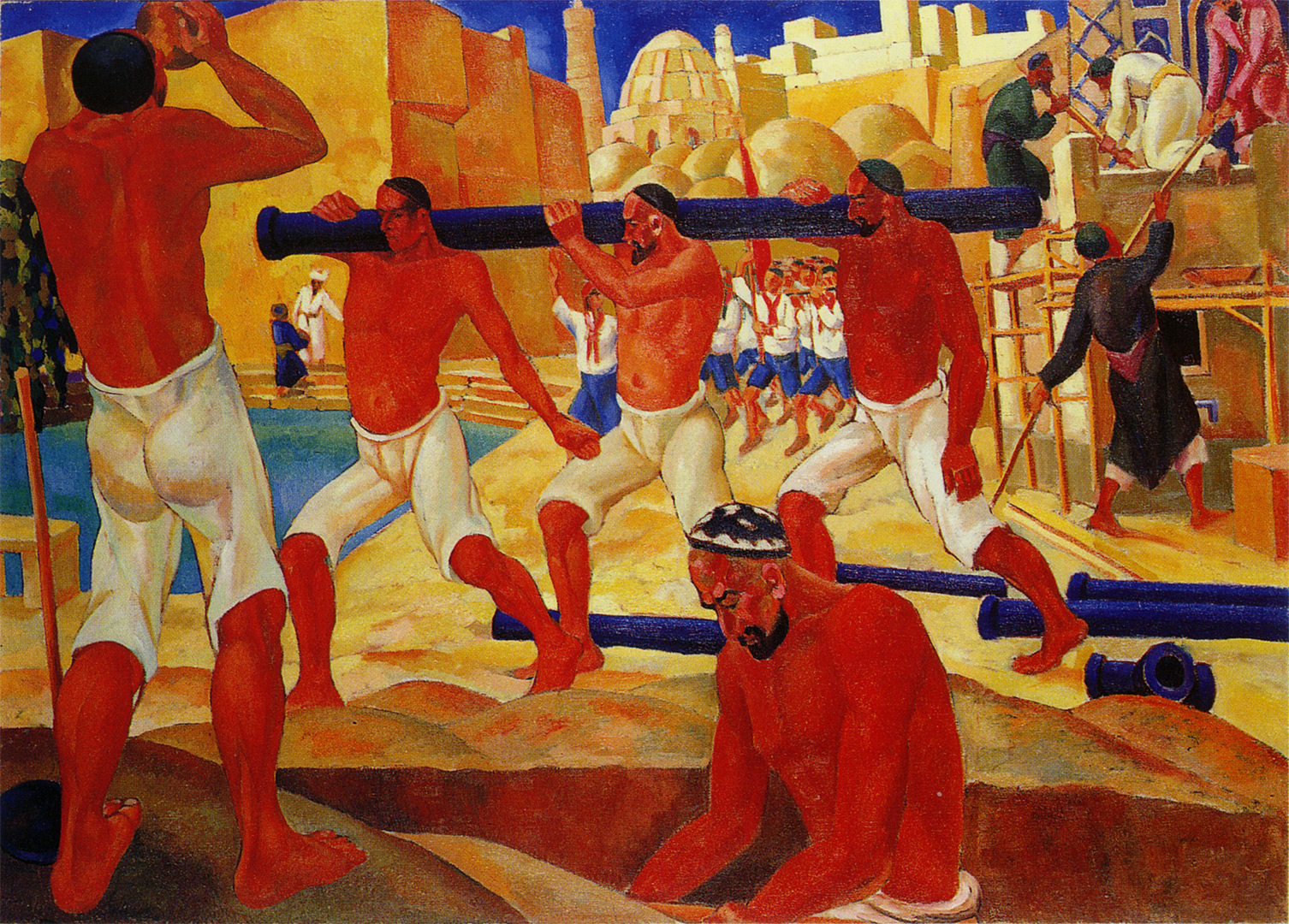
In the foreground, in the lower part of the painting, an Uzbek man is depicted to the waist, in left profile, wearing a dark skullcap with white spots. His head is lowered, and his face and body are rendered in a dark orange tone.
On the left, at the edge of the canvas, with his back to the viewer, a full-length figure of an Uzbek man stands in close-up, wearing white knee-length trousers. Throwing his head back, he drinks water from a jug.
Behind them, in the center, three Uzbek men walk one after another, wearing white knee-length trousers and green skullcaps, carrying a blue pipe. Behind them is a group of Pioneers. In the center, a Pioneer holds a red banner.
On the right, a building is under restoration; on the left, there is a green body of water. In the background, an architectural ensemble with domes is depicted. Along the upper edge, fragments of blue sky are visible.
Nikolai Grigorev (1890-1943)
"At the Coffeehouse"
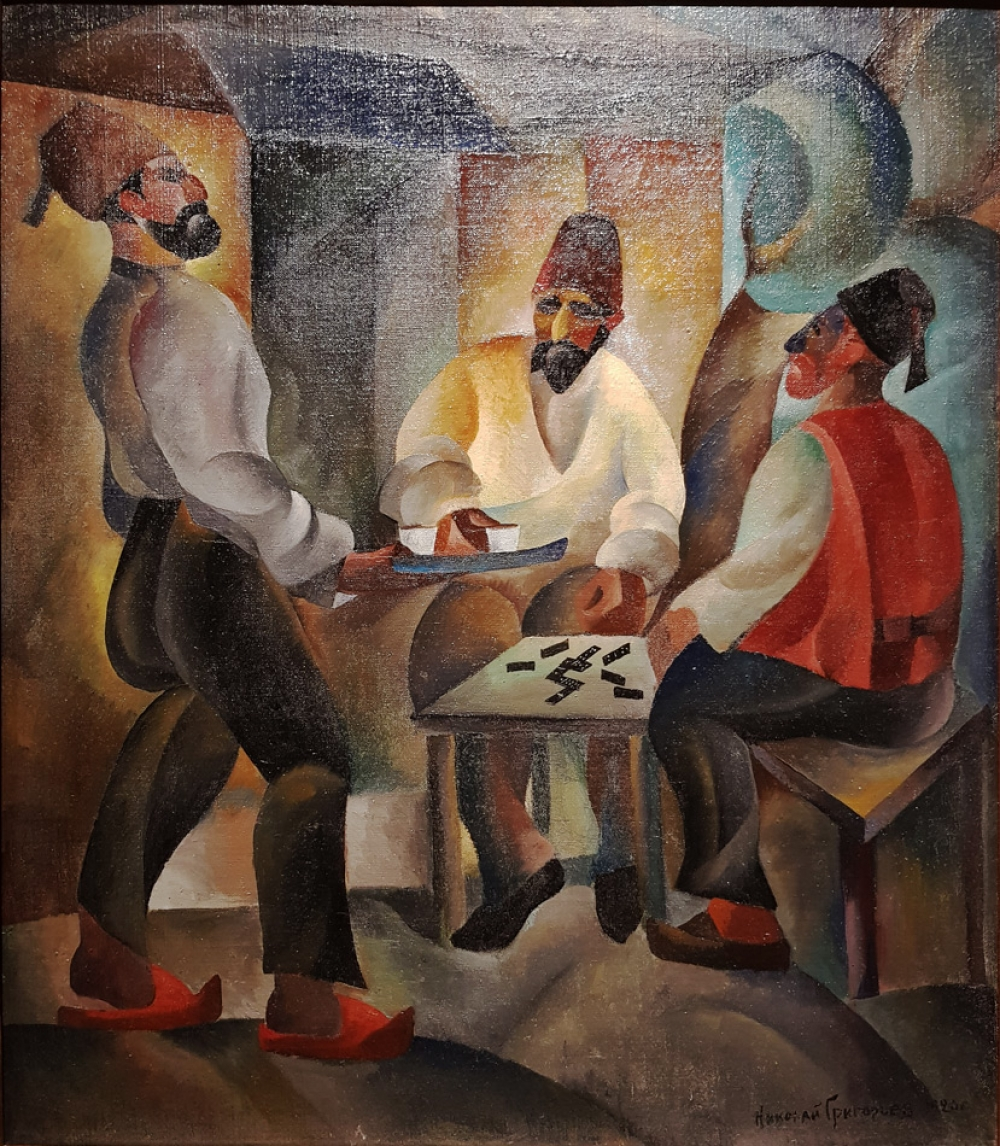
In the foreground, there is a group of three people in Eastern attire, all wearing Turkish caps. On the right, two seated men are playing dominoes. On the left, a man is holding a tray with two white cups. Behind them is the facade of a building with a deep doorway and a blue canopy above it. At the top, a corner of a dark blueberry-colored roof is visible. On the right, near the house, there is a curved tree trunk.